
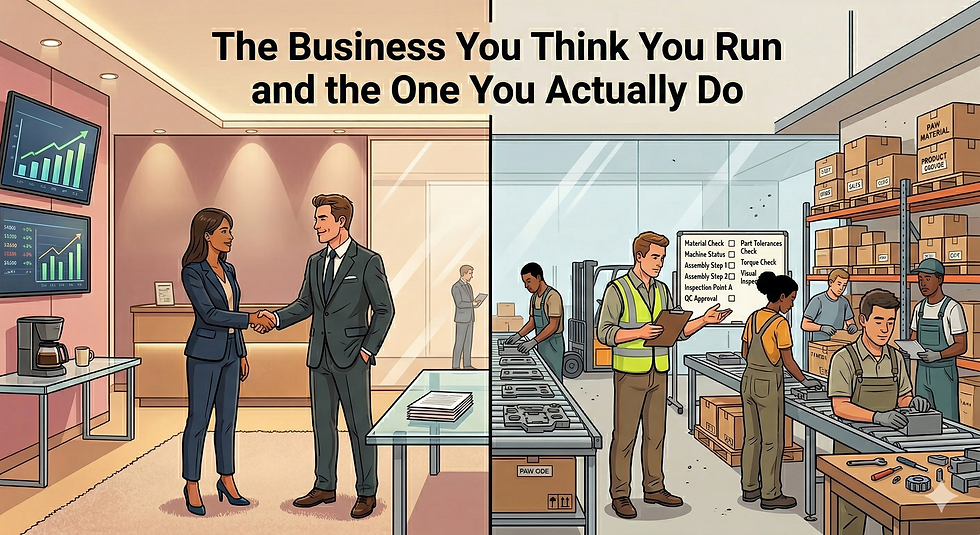
The Business You Think You Run and the One You Actually Do

Updated: Sep 27
Your brand says one thing. Your operation says another.
In many organisations, these two realities coexist without anyone noticing - until something goes wrong. A decision gets made that doesn't fit the operational constraints. An expectation is set that the floor can't meet. A process is resisted because no one understands why it exists.
There is a scene in The Founder - the film about Ray Kroc and the building of McDonald's - that stays with you. It is not about burgers or franchising. It is about a man who understood his business at a level most operators never reach. He knew exactly what needed to be standardised, what the customer expected, and what the operation had to deliver every single time - in every location, without exception.
That clarity is what built the system.
Know your business. Not the brand. Not the aspiration. The actual business - its constraints, its cost drivers, its operational reality. Because in my experience, the most damaging problems inside an organisation rarely come from a lack of tools or processes. They come from people - sometimes very senior people - who simply don't understand the business they are in.
When the Brand and the Operation Tell Different Stories
I worked with a company that had built a strong external identity around innovation and premium positioning. The branding was sophisticated. The language was high-tech. The product commanded a price point that reflected that image - and rightly so, because the product itself was genuinely good.
But the operation was low-tech production. The floor reality - materials, workflows, quality controls, cost structure - was grounded in physical, manual, process-driven manufacturing. And most people outside of operations, QC, and R&D had no idea. They thought they worked for a technology company.
The consequences showed up everywhere. Decisions were made about inventory, procurement, and capacity based on assumptions that didn't reflect the real production constraints. Expectations were set - internally and externally - that the operation couldn't always meet. And when things went wrong, the people who needed to understand why often couldn't, because they had never really understood what the business was actually doing.
The gap between how a business presents itself and what it actually does is not just a marketing problem. It is an operational one.
When Regulation Changes Everything - and Most People Don't Notice
The second example is different in nature but identical in root cause.
I worked with a company going through a transition to GMP - Good Manufacturing Practice - regulated ways of working. For the operations and quality teams, this was a fundamental shift. Every process, every record, every material movement needed to meet a defined standard. The documentation wasn't bureaucracy - it was the proof that the product was what it claimed to be. In a regulated environment, that proof is the business.
But for most of the organisation - commercial, finance, management - it was background noise. They didn't connect the new ways of working to the business they were actually in. They didn't understand that in a regulated environment, a shortcut isn't just an operational risk. It is a compliance risk, potentially a commercial one, and in some cases a legal one.
The resistance wasn't malicious. It was ignorance - not of the procedures, but of why those procedures existed. People didn't understand the constraints of the business they were operating in. And that misunderstanding made every change harder, slower, and more expensive than it needed to be.
Regulation is not something that happens to a business. In certain industries, it is the operating environment. If your people don't understand that, they will always be working against it.
The Common Thread
Two different companies. Two different industries. Two completely different operational challenges. The same underlying problem.
In both cases, people who had influence over decisions - how things were resourced, prioritised, and managed - did not have a clear enough understanding of what the business actually was. Not the brand. Not the aspiration. The real constraints, the real cost drivers, the real consequences of getting it wrong.
That gap - between perceived business and actual business - is where operational problems are born. Inventory policies that don't fit the product. Planning processes that ignore regulatory requirements. Cost decisions that look right on paper but are disconnected from floor reality.
Where Else This Shows Up
The perception gap does not stay in the warehouse. It travels through the entire organisation and surfaces wherever a decision is made by someone who doesn't fully understand the business they are making it for.
The sales pitch. A sales manager who understands the brand but not the supply chain will sell on capability that doesn't exist - lead times the operation can't meet, flexibility it doesn't have, service levels it was never designed to deliver. Not out of dishonesty, but out of genuine unawareness. The result is a customer who was sold one thing and receives another. That gap - between what was promised and what was delivered - is one of the most common and most preventable sources of customer attrition. It is not a sales problem. It is a business understanding problem.
Market introduction and product launches. New product launches and market entries are where this gap is most expensive. Risk assessments get done at senior level, with the right intentions and the wrong information. The people in the room understand the strategy. The people who understand the operational reality - the production constraints, the supplier lead times, the quality control requirements, the regulatory implications - are often not in the room at all. Middle management, who live the day-to-day, are briefed after the decision is made rather than consulted before it. The launch proceeds on assumptions that the floor knows are wrong, and nobody says so until it is too late.
Inventory policy. Inventory is one place where this shows up in numbers. A business that genuinely understands its operation - its demand pattern, its supply constraints, its product characteristics, its cash flow reality - builds an inventory policy that fits. A business where those things are not widely understood ends up with a policy designed for a different kind of company. Safety stock levels set without understanding lead time variability. Reorder points inherited from a previous system. Rotation methods applied because they are standard, not because they fit the product.
The common thread across all of these is the same. Decisions made without a clear understanding of the operational reality they will land in create gaps - between customer expectations and delivery, between launch plans and execution capability, between policy and practice. Those gaps have a cost. And they are almost always avoidable.
If that gap exists in your organisation - between how the business is understood and what it actually requires operationally - that is where the work starts.
We are happy to have that conversation.
The QA Internal Audits Kit and Risk Prevention FMEA - The Shield Quality Kit give you the tools to see the operation as it actually is - and close the gap between what you think you run and what you actually do.


Comments